

…..Targets 545,000 Children In Lagos
The United Nations Children’s Fund (UNICEF) is supporting plan to register 3.69m children under one year across 15 priority states in Nigeria with the target of 545, 000 in Lagos.
The states include Bayelsa, Borno, Ebonyi, Gombe, Jigawa, Kano, Kastina, Kebbi, Kogi, Niger, Lagos, Taraba, Yobe, Zamfara and the Federal Capital Territory, Abuja.
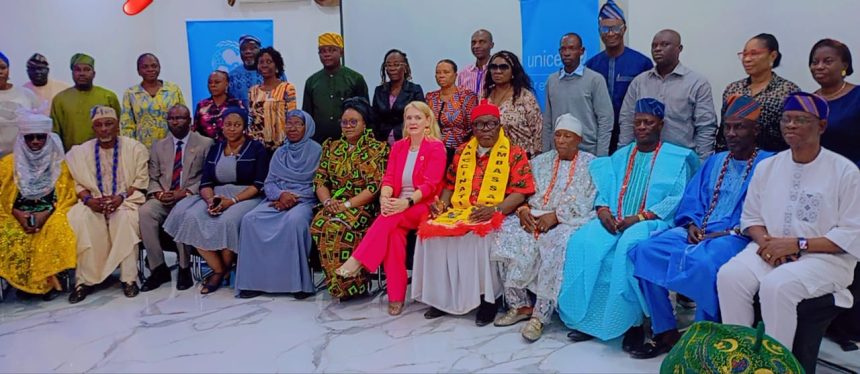
Speaking at a Multi-sectoral Stakeholders Dialogue on Birth Registration held in Lagos on Monday, the Chief of UNICEF Lagos Field Office, Celine Lafoucriere pointed to the fact that birth registration is the first line of protection for every child hence the need for the country to make it a priority.
She noted that without registration, millions of Nigerian children remain invisible and cannot access healthcare, education or social services.
The dialogue, with the theme: “Every Child Counts: Accelerating Birth Registration in Lagos State,” had in attendance participants from National Population Commission (NPC), Ministries of Health, Education, Youth and Social Development, Association of Local Governments of Nigeria (ALGON), religious and traditional leaders, civil society and the media.
She commended Lagos for been at the front in the national campaign, with 94 per cent of children under five already registered, one of the highest coverage rates in Nigeria.
“Lagos State has made real progress. With 94 percent of children under five registered, you are at the forefront. But the work is far from done.
Hard-to-reach communities, informal settlements, and low-income families still face barriers. Our goal is to leave no child behind,” she said.
She disclosed that in September 2025, the NPC with UNICEF’s support, began distributing over 16 million birth certificates nationwide, out of which Lagos received the highest allocation of more than six million.
“This shows both the scale of what Lagos has accomplished and the trust placed in your systems,” she said.
The UNICEF Chief Field Officer explained further that the current focus is on registering children under one year, as previous national drives had covered millions under five.
“We have managed to register over 12 million children under five in the last three years. This year, we’re concentrating on newly born babies because we should have far fewer unregistered under-fives now.
The goal is to make birth registration second nature for every parent,” she explained.
She warned that unregistered children remain invisible in national statistics, which affects social protection and development planning.
“When you have a census or population survey, unregistered children do not exist. They are missing from budgets and social protection plans. Without legal identity, they can’t benefit from government programmes,” she added.
Pointing the progress of birth registration in Lagos, Lafoucriere said the foundation is in place and can safely say that Lagos is ready.
She disclosed that all birth registration and health facility trainings have been completed across the 20 Local Government Areas, and all registration supplies, including tablets, have been distributed.
She advised that the Ministry of Health must integrate registration into immunization and maternal health services.
“Education authorities must require birth certificates for school enrolment. Traditional and community leaders must champion registration as a civic duty.
The media must amplify messages that resonate across our diverse communities,” she said.
She also revealed that traditional birth attendants, (TBAs), would be trained to register babies delivered outside hospitals, especially in riverine and rural communities.
The Federal Commissioner, NPC, Lagos, Mrs Olayinka Oladunjoye in her remarks urged community leaders, religious groups, and local councils to intensify mobilisation efforts for birth registration.
“Without registration, there is no identity. And without identity, we can’t plan for them,” she said.
Oladunjoye explained that accurate registration data helps government plan for schools, healthcare facilities, and infrastructure.
She commended UNICEF, ALGON, and other partners for their continued collaboration, describing the campaign as a shared responsibility.
“All our children must be registered, and certificates must be given. We appreciate UNICEF for being a strong partner and for always standing by us,” she said.
The state Director of National Orientation Agency (NOA), Dr. Mustafa Tukur commended UNICEF for the project adding that the agency is poised to support the project.
“We shall activate all our information from grassroot to work in collaboration with the National Population Commission (NPC) to achieve the goal.”
Welfare Officer, Child Protection Network, CPN, and Project Coordinator for Yanuora Children’s Care Foundation, Mrs. Olajumoke Otitoloju identified bottlesnecks and opportunities, stating that despite Lagos’ progress, several barriers still hinder universal registration, particularly among rural and low-income families.
“Birth registration is the first legal identity of a child’s existence in the community. When a child is not registered, that child is invisible. Millions of children in rural and low-income areas still fall through the cracks,” she said.
Otitoloju, who described CPN as a national network of child protection NGOs, highlighted the lack of awareness as a major bottleneck.
“We don’t have enough campaigns or awareness for parents and caregivers on the importance of birth registration. Because of this, many do not see why it matters,” she said.
She raised concerns about the unofficial personnel who exploit the system by issuing fake certificates, discouraging genuine registration.
She called for stronger collaboration among government ministries, agencies, health workers, and civil society to strengthen data collection and policy planning.
“When we have accurate data of children, the government can make policies that favour their welfare. But when a child is not registered, that child doesn’t exist in the system,” she noted.
Speaking on solutions, Otitoloju proposed the establishment of birth registration desks in primary schools, since school enrolment marks a child’s next point of identification.
“When a child is admitted into school without a birth certificate, parents should be directed to register immediately.”
This she said would help improve compliance.
She also urged faith-based organisations to demand proof of registration during naming ceremonies.
“If churches and mosques request for birth certificates before naming a child, it will help families understand its importance. It’s not just about giving a name it’s about giving an identity,” she explained.
Participants at the end of the programme called for collective action from government, partners and communities to mobilize resources, build capacity, generate demand and integrate services.