
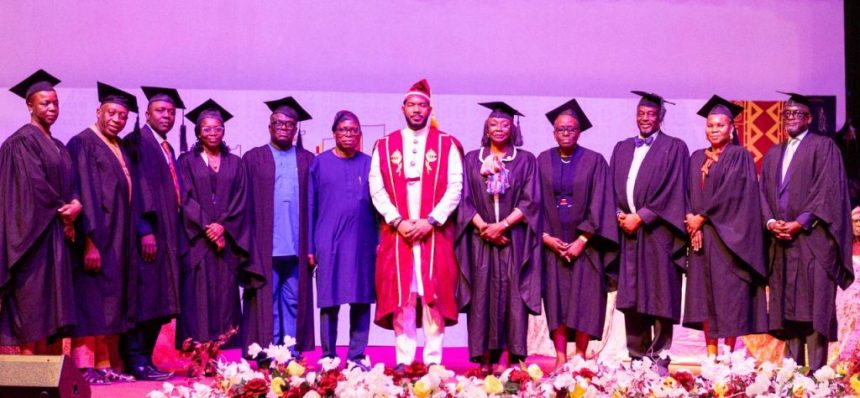
University of Lagos (UNILAG)’s 56th convocation lecturer, Mr. Orondaan Otto, Founder/Executive Director, Slum2School Africa has called for a clear, compelling, long-term national vision for education, one that is not owned by a government, a party or a minister but by the nation itself.
Mr. Otto stated this while delivering the lecture entitled: “Maximizing Nigeria’s Demographic Dividend through Urgent Education Reform for Global Competitiveness in the 21st Century’ at the university on Monday.
He added that Nigeria’s greatest weakness in education is not lack of effort or policy documents but rather lack of continuity, coordination and legally protected national direction.
Otto added that such a vision cannot be written in Abuja alone but must be born of national consensus by traditional councils, religious leaders, educators, labour unions, the private sector, and political leaders across party lines.
The vision he said must be encoded into law, anchored by an Education Vision Act, and given constitutional protection so that it cannot be altered by political cycles.
“This is crucial, because when a child knows the destination, education becomes purposeful, and learning becomes meaningful,” he added.
He stated further that to raise generations of Nigerians who think, act ethically and build boldly, rooted in African identity, committed to national transformation, and capable of compelling and leading anywhere in the world, there is need for continuity, cognition, character, competence, cultural confidence, commitment and competitiveness capable of compelling and leading anywhere in the world.
The convocation lecturer also called for institutionalizing fifteen years of compulsory education and transform schools into centers of excellence with Nigeria adopting 3-12-4 education model where each stage has a clear national purpose and this would require amending the Universal Basic Education Act to extend compulsory education as a national responsibility.
“The Child Rights Act must move from intention to full enforcement. The girl child deserves equal rights, protection, and opportunity everywhere in Nigeria, not in theory but in practice.”
Otto said there is also the need to reposition teaching as Nigeria’s most elite profession because the future of a nation does not first sit in parliament or boardrooms, it sits in a primary-one classroom, listening to the voice that stands in front of it.
“First, we should elevate teaching to a four-year professional degree aligned with global best practices that includes strong pedagogy, high entry requirements, supervised classroom residency, licensing and above-average pay.
“Secondly, gradually phase out the National Certificate of Education by transitioning all Colleges of Education into degree -awarding Universities of Education offering Bachelor’s degrees in education and Bachelor’s degrees in teaching as the minimum qualification for entry into the profession.”
He also advised on the entry requirements into teacher education programmes by increasing the cut-off score from 100 to 400 at least a 70 percent cut off mark, ensuring teaching attracts academically strong candidates.
“Fourthly, ensure all teachers are registered with the TRCN and lastly it is important to raise the reputation of the teaching profession by giving teachers the maximum social respect.”
He also spoke extensively on curriculum, urging on standardize and recolonize the national curriculum with policy preserving indigenous languages.
“We must establish a single, national curriculum standard that guarantees every child in Nigeria learns the same core skills, values, and competencies, regardless of location..”
He said that while the debate around mother-tongue instruction is valid and important, education policy must ultimately be guided by practicality, affordability, equity and future opportunity, not emotion or symbolism.
“Indigenous languages in Nigeria should therefore be strengthened and taught in schools as subjects of culture and identity, while English language serves as the common language of instruction that ensured inclusion, mobility and national cohesion,” he added.
He further said that reengineering education around skill development from day one is important, adding that as a serious nation, we must not wait until adulthood to teach productivity.
He explained that skills must be embedded from the very beginning of schooling, not treated as an optional add-on or vocational fallback.
He also suggested equalisation of Universities, Polytechnics, and TVET institutions. “The solution is clear and urgent, Nigeria must reform the legal framework that distinguishes universities, polytechnics, and colleges of education, transitioning them into Universities of Education with equal status and degree awarding powers.
“All should award bachelor’s degrees of equal legal status, BSc, BEng through 3 to 4 years pathways with standardized curriculum, differentiated by specialization not hierarchy.”
He however added that while this would not be an easy feat, it would be the most secure pathway to truly begin the journey to restore dignity to technical and professional pathways and shift the system from status to skills-driven development.
Speaking on the need for fully integrated data-driven governance in education, Otto said that one of Nigeria’s fundamental challenges is that we do not know ourselves real time to plan effectively with the country making use of weak, fragmented, and outdated data for policy making.
He said Nigeria needs a National Education Identity Number (NEDIN) which he described as a lifelong, education-only number issued to every child at birth or early childhood, securely derived from the NIN without revealing it.
He explained further that the NIN remains the protected root identity, while NEDIN becomes the education-facing reference.
“With NEDIN, every child’s enrolment, attendance, learning outcomes. Transitions, and completion become traceable, planning becomes accurate, funding becomes fair and dropouts become visible.”
He added that this is how the country can harmonise data without compromising privacy or national security, stating further that to achieve data harmonization, all schools, public and private should be digitally registered in harmonized national system jointly implemented by federal, state and local governments.
He however pointed out that this is not about surveillance, it is about visibility, planning and accountability in service of children.
Lastly, the lecturer also called for the creation of two strategic education ministries, Children and Basic Education and Higher Education and Research, adding that with this education becomes more functional governance and not fragmented policy.
Otto said that if Nigeria finally decided to act in unity, build her political will, be opened to new thinking and convert her potential into power, the country will stand among the three most populous on earth, with a population estimate of about 410 million people.
“That population he said would no longer be framed as a burden, it became the greatest strategic advantage any nation on earth could possess,” he stated.